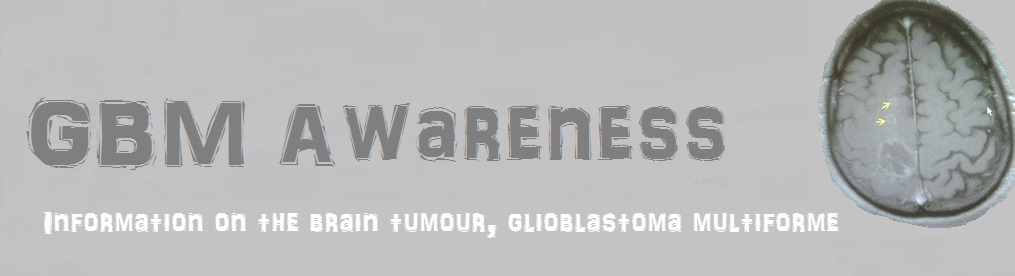
Glioblastoma (GBM) (previously known as glioblastoma multiforme) is the most common primary brain tumour in adults, with an incidence of 4 per 100,000 people in Canada according to the Brain Tumour Registry of Canada. GMBs fall into the category of grade IV astrocytomas, arising from mutated glial or neural stem cells. GBMs are particularly invasive, aggressive, resistant to treatment, and almost universally fatal, with an average life expectancy of approximately 14 months. (1) Although there is currently no cure for GBMs, researchers are always coming up with new therapies and technology.
Facts About GMBs
- may have evolved from a low-grade astrocytoma or an oligodendroglioma
- accounts for 17% of all primary brain tumours
- more common in men than women
- most common in adults 45-75 years old
- only 3% of childhood brain tumours are glioblastomas
- negative prognosis factors include increased age, biopsy rather than resection, bilateral tumour involvement, poor neurological function, and radiation therapy alone rather than radiation and chemotherapy
Symptoms
- seizure
- nausea
- vomiting
- headache
- hemiparesis (weakness on one side of the body) or unsteadiness
- memory or personality changes
- sometimes asymptomatic until the tumour gets large- also depends on where the tumour is located, as to what symptoms will occur
Learn about brain anatomy here.
Learn more about brain tumours in this video: Mayo Clinic’s Brain Tumour Diagnosis and Treatment
Dreyfuss, J. M., Johnson, M. D., & Park, P. J. (2009). Meta-analysis of glioblastoma multiforme versus anaplasticastrocytoma identifies robust gene markers. Molecular Cancer, 871-80.
Helseth, R. R., Helseth, E. E., Johannesen, T. B., Langberg, C. W., Lote, K. K., Ronning, P. P., & Meling, T. R. (2010). Overall survival, prognostic factors, and repeated surgery in a consecutive series of 516 patients with glioblastoma multiforme. Acta Neurologica Scandinavica, 122(3), 159-167. doi:10.1111/j.1600-0404.2010.01350.x
National Brain Tumor Association. (2011). Glioblastoma multiforme (GBM). Retrieved March 31, 2012 from http://www.braintumor.org/patients-family-friends/about-brain-tumors/tumor-types/glioblastoma-multiforme.html
Park, J. K., Hodges, T., Arko, L., Shen, M., Dello Iacono, D., McNabb, A., Olsen Bailey, N., Nguyen Kreisl, T., Iwamoto, F. M., Sul, J., Auh, S., Park, G. E., Fine, H. A., and McL. Black, P. (2010). Scale to predict survival after surgery for recurrent glioblastoma multiforme. Journal of Clinical Oncology, 28(24), 3838-3843.
(1) Radiotherapy plus concomitant and adjuvant temozolomide for glioblastoma.
Roger Stupp, Warren P. Mason, Martin J. van den Bent, Michael Weller, Barbara Fisher, Martin J. B. Taphoorn, Karl Belanger, Alba A. Brandes, Christine Marosi, Ulrich Bogdahn, et al.
N Engl J Med. 2005 Mar 10; 352(10): 987–996. doi: 10.1056/NEJMoa043330
Effects of radiotherapy with concomitant and adjuvant temozolomide versus radiotherapy alone on survival in glioblastoma in a randomised phase III study: 5-year analysis of the EORTC-NCIC trial.
Roger Stupp, Monika E. Hegi, Warren P. Mason, Martin J. van den Bent, Martin J. B. Taphoorn, Robert C. Janzer, Samuel K. Ludwin, Anouk Allgeier, Barbara Fisher, Karl Belanger, et al.
Lancet Oncol. 2009 May; 10(5): 459–466. Published online 2009 Mar 9. doi: 10.1016/S1470-2045(09)70025-7